Table of contents
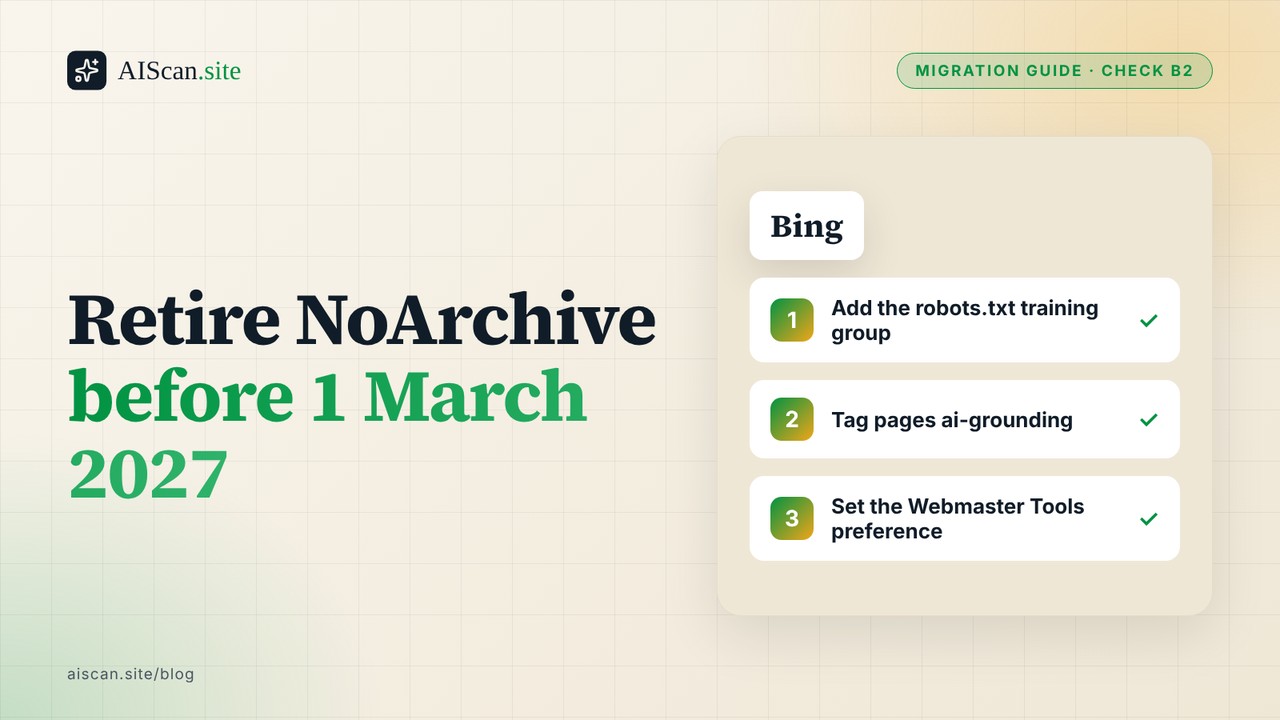
If you used noarchive or nocache to keep your pages out of Copilot or out of Microsoft's model training, that protection ends on 1 March 2027. From then on Bing reads two new preferences, ai-training and ai-grounding, and a page that still carries only the old tags is treated as Allow for both. The fix takes one robots.txt group, two meta tags per protected page template, and one setting in Bing Webmaster Tools before the deadline.
Nothing changes before 1 February 2027. This is a migration plan for a change Microsoft has announced, not a report of behaviour already live.
Quick summary
| You used this for AI | It meant (2023 rules) | Publish this instead | Plus |
|---|---|---|---|
noarchive | Not in Bing chat answers, not used for training | robots.txt User-Agent: __usage_ai-training + Disallow: /, and <meta name="Bingbot" content="ai-grounding:disallow"> on each page | Temporary grounding preference in Bing Webmaster Tools before 1 Mar 2027 |
nocache (alone or with noarchive) | In answers as URL, title and snippet only; only those three used for training | Training: the same robots.txt group. Grounding: ai-grounding:disallowextended or ai-grounding:disallow | The same temporary preference, if you want grounding limited |
| Either, but you only cared about training | Training opt-out | The robots.txt group alone | Nothing in Bing Webmaster Tools; there is no temporary training setting |
| Neither | Allowed | Nothing | Both values default to Allow |
The one trap: publishing the robots.txt group without the grounding tag. Microsoft's announcement says that once Bing finds a new preference on a site, it disregards NoArchive and NoCache on that site, so the half-migrated site loses its grounding protection on 1 February, a month early.
Why the old tags are being retired
In Microsoft's September 2023 announcement (retrieved 14 November 2026), Bing reused two cache directives as its AI controls. NoArchive kept content out of Bing Chat answers and out of training. NoCache allowed answers to show only the URL, title and snippet. A page with both was treated as NoCache. The Bing robots meta page still describes them that way today, with a banner pointing to the replacement.
The problem was that one tag carried two decisions. Bing's AI preferences FAQ (Q3) puts it plainly: the tags "were built to control cached pages in search and treated training and grounding as a single decision." Think of it as one light switch wired to two rooms. The 30 October 2026 announcement gives each room its own switch:
- AI Training, set site-wide or by path in robots.txt with the shared
__usage_ai-traininggroup from the IETF AI Preferences draft, or per page. A page value overrides robots.txt. - AI Grounding, per page only:
allow,disallowextended(Microsoft's own products such as Copilot and Microsoft 365 only, not grounding sold to third parties through Web IQ or Foundry) ordisallow. "There is no site-wide robots.txt grounding preference."
After the switch, Bing returns NoArchive and NoCache to their original meaning in search (FAQ Q20). They still control the cached copy; they just stop controlling AI.
The dates that matter
| Date | What happens (Microsoft, 30 Oct 2026) |
|---|---|
| 15 Dec 2026 | Temporary grounding preferences open in Bing Webmaster Tools, only for sites using NoArchive or NoCache on that date |
| 1 Feb 2027 | Bing starts honouring ai-training and ai-grounding as it crawls |
| 1 Mar 2027 | NoArchive and NoCache stop counting for training and grounding |
| 30 Sep 2027 | Any temporary grounding preference still in place expires |
The temporary preference exists because a tag only counts once Bingbot recrawls the page, and Microsoft says that recrawl "may not take place between February and March 1." Skip it and, per FAQ Q18, your NoArchive pages "default to Allow for grounding until Microsoft recrawls them."
What our checker showed
We wrote a 47-line Python checker that reads, for one URL, the site's robots.txt for a __usage_ai-training group, every robots and Bingbot meta tag, and the X-Robots-Tag header, then prints the effective training and grounding values in three windows. We ran it on 14 November 2026 (Python 3.11.18) against 8 local test pages, each with its own robots.txt.
| Test page (8 tested, 14 Nov 2026) | Before 1 Feb 2027 | 1 to 28 Feb 2027 | From 1 Mar 2027 |
|---|---|---|---|
robots: noarchive | training disallow, grounding disallow | same | both allow |
robots: noarchive, nocache | both URL/title/snippet only | same | both allow |
robots: noarchive + bingbot: nocache | both URL/title/snippet only | same | both allow |
X-Robots-Tag: noarchive header | both disallow | same | both allow |
noarchive + robots.txt training group only | both disallow | grounding allow | grounding allow |
noarchive + robots.txt group + ai-grounding:disallow | both disallow | both disallow | both disallow |
New tags only (ai-training:disallow, ai-grounding:disallowextended) | both allow | as set | as set |
| Nothing | both allow | both allow | both allow |
Row five is the half-migration. It is the case most guides miss, and it is the one the checker flags with a warning. Row six is the target state.
Two honest limits. The checker cannot see a temporary preference you recorded in Bing Webmaster Tools, so rows one to five assume none. And the February column uses the stricter, site-wide wording from Microsoft's announcement; FAQ Q20 words it per use ("for the corresponding training or grounding use covered by a new preference"). Until Microsoft settles the difference, migrate training and grounding together and you are safe under either reading.
We also ran it on our own four sites (aiscan.site, xspeedcache.com, storeseo.com, bettershield.ai). All four print Allow in every window: no legacy tags, no training group. That is deliberate, because we want AI answers to cite us.
How to migrate, step by step
- Find every page that carries the old tags. Run
curl -s https://yoursite.com/page | grep -io '<meta name="\(robots\|bingbot\)"[^>]*>'on one URL per template, andcurl -sIfor anX-Robots-Tagheader. Paywalled templates are the usual hit: Microsoft's 2023 post noted many paywall sites use only NoArchive. - Decide the goal per template, not per tag. Training and grounding are now separate. A publisher that wants Copilot citations but no training sets training to Disallow and leaves grounding alone.
- Publish the training preference. For the whole site, add to robots.txt:
Give it its own group: do not put theUser-Agent: __usage_ai-training Disallow: /User-Agent: __usage_ai-trainingline directly under anotherUser-Agentline, or the two share one set of rules (RFC 9309 groups consecutive user-agent lines). For one section only, use the path (Disallow: /premium/). - Publish the grounding preference on each page you want protected. Use one value per tag, as Bing's own examples do:
or the header<meta name="Bingbot" content="ai-grounding:disallow">X-Robots-Tag: Bingbot: ai-grounding:disallow. Per-stack config (Next.js, Astro, WordPress, Cloudflare, Nginx, Apache, Netlify, Vercel) is in our every-platform guide to Bing's ai-training and ai-grounding. - Record the temporary grounding preference in Bing Webmaster Tools after it opens on 15 December 2026, and before 1 March 2027. Microsoft has not yet published the menu path, so look for it in your site's Bing Webmaster Tools account once it opens.
- Leave NoArchive and NoCache in place if you still want them for the search cache. They do no harm after the switch.
- Ping Bing. IndexNow can prompt a recrawl of changed pages, though Microsoft says it "does not guarantee a recrawl date."
On WordPress, ThinkRank is where we put the robots.txt group: one plugin owns the file instead of three fighting over it, and it migrates settings from Rank Math, Yoast, AIOSEO and SEOPress. Its per-post controls write the standard robots tag, so the Bingbot grounding tag still needs the small snippet in the every-platform guide.
Bing's own warning belongs here: choosing disallowextended or disallow for grounding "will significantly reduce your content's visibility in AI-generated experiences," though it does not affect Bing search results.
Check that it worked
Start with a scan: run npx aiscan-cli yoursite.com or paste your URL at aiscan.site. Check B2 (explicit AI bot rules) parses your robots.txt groups, so it confirms the file still reads cleanly after you add __usage_ai-training. AIScan does not score the page-level Bing values or the legacy tags, so check those with the script. The bot access checks page explains what B2 grades.
By hand:
curl -s https://yoursite.com/robots.txt | grep -i -A2 '__usage_ai-training'
python3 bingprefs.py https://yoursite.com/premium/article
The checker:
#!/usr/bin/env python3
"""Bing AI preference checker: legacy NoArchive/NoCache vs ai-training/ai-grounding."""
import re, sys, urllib.request, urllib.parse
UA = {"User-Agent": "Mozilla/5.0 bingprefs-check"}
def get(url):
    try:
        with urllib.request.urlopen(urllib.request.Request(url, headers=UA), timeout=20) as r:
            return r.headers.get_all("X-Robots-Tag") or [], r.read().decode("utf-8", "replace")
    except Exception:
        return [], ""
def robots_training(url):
    u = urllib.parse.urlsplit(url); _, txt = get(f"{u.scheme}://{u.netloc}/robots.txt")
    rules, agents, in_rules = [], [], False
    for line in txt.splitlines():
        k, _, v = line.split("#")[0].partition(":"); k, v = k.strip().lower(), v.strip()
        if k == "user-agent":
            if in_rules: agents, in_rules = [], False
            agents.append(v.lower())
        elif k in ("allow", "disallow") and v:
            in_rules = True
            if "__usage_ai-training" in agents: rules.append((len(v), k == "allow", k, v))
    hits = [r for r in rules if (u.path or "/").startswith(r[3].rstrip("*"))]
    return max(hits)[2] if hits else None
def page_directives(url):
    headers, html = get(url); out = []
    for h in headers:
        h = re.sub(r"(?i)^\s*(bingbot|robots)\s*:\s*", "", h); out += h.split(",")
    for m in re.finditer(r'<meta[^>]+name=["\'](?:robots|bingbot)["\'][^>]+content=["\']([^"\']+)', html, re.I):
        out += m.group(1).split(",")
    return {d.strip().lower().replace(" ", "") for d in out if d.strip()}
def report(url):
    d, rt = page_directives(url), robots_training(url)
    new = {k: v.split(":")[1] for v in d for k in ("ai-training", "ai-grounding") if v.startswith(k + ":")}
    legacy = "nocache" if "nocache" in d else "noarchive" if "noarchive" in d else None
    old_t = {"nocache": "URL/title/snippet only", "noarchive": "disallow", None: "allow"}[legacy]
    old_g = {"nocache": "URL/title/snippet only", "noarchive": "disallow", None: "allow"}[legacy]
    has_new = bool(new) or rt is not None
    new_t = new.get("ai-training") or rt or "allow (default)"
    new_g = new.get("ai-grounding") or "allow (default)"
    feb_t, feb_g = (new_t, new_g) if has_new else (old_t, old_g)
    print(url); print(f"  legacy: {legacy or 'none'} | robots.txt training: {rt or 'none'} | page: {sorted(new.items()) or 'none'}")
    print(f"  before 1 Feb 2027 : training {old_t:24} grounding {old_g}")
    print(f"  1-28 Feb 2027     : training {feb_t:24} grounding {feb_g}")
    print(f"  from 1 Mar 2027   : training {new_t:24} grounding {new_g}")
    if legacy and new_g.startswith("allow") and old_g != "allow":
        print("  WARNING: grounding protection ends; add ai-grounding to the page and a temporary preference in Bing Webmaster Tools")
for u in sys.argv[1:]: report(u)
Output on a fully migrated page (row six of the lab):
  legacy: noarchive | robots.txt training: disallow | page: [('ai-grounding', 'disallow')]
  before 1 Feb 2027 : training disallow                 grounding disallow
  1-28 Feb 2027     : training disallow                 grounding disallow
  from 1 Mar 2027   : training disallow                 grounding disallow
Pass means: the three rows print the values you chose and no WARNING line appears. The path match is a simple prefix match, which covers the Disallow: / and Disallow: /path/ forms Bing documents; it does not expand * wildcards mid-path.
Mistakes to avoid
- Writing
ai-groundinginto robots.txt. Bing reads no grounding value there (FAQ Q11). - Removing NoArchive before the new values are live and recrawled.
- Assuming an Allow unblocks crawling. These values govern use, not access; a robots.txt rule that blocks Bingbot still blocks it.
- Confusing these with the
noaitags. Bing's robots meta page does not list them; see what noai and noimageai actually do.
Related guides
What the shared token means and who reads it: the __usage_ai-training robots.txt token. Adding it on your stack: the token on every platform. Why Google-Extended can still win over it for Google: Google-Extended overrides usage-ai-training.
Your next step
Scan your site at aiscan.site, confirm check B2 passes once the __usage_ai-training group is in, then run the checker on one URL per protected template and put 15 December in your calendar for the Bing Webmaster Tools step. Setup guides for every other check are at /guides.
Frequently asked questions
I use noarchive to keep pages out of Copilot. What happens on 1 March 2027?
Bing stops reading noarchive as a grounding or training preference, so those pages become Allow for both unless you publish ai-grounding:disallow on each page and record a temporary grounding preference in Bing Webmaster Tools before that date (Microsoft, 30 Oct 2026).
I added the __usage_ai-training group to robots.txt and the checker now says grounding is allow. Why?
Microsoft's announcement says that once Bing detects a new preference on a site it disregards NoArchive and NoCache there. The robots.txt group carries no grounding value, so grounding falls back to Allow. Add ai-grounding:disallow or ai-grounding:disallowextended to the pages you want protected.
I can't find the temporary grounding preference in Bing Webmaster Tools. Is it missing?
Microsoft says it opens on 15 December 2026, and only for sites using NoArchive or NoCache on that date. Before then, or on a site without the old tags, there is nothing to record.
My page has both noarchive and nocache. Which one does Bing use today?
NoCache. Microsoft's 2023 announcement says content with both tags is treated as NoCache, which allows the URL, title and snippet in answers. Choose ai-grounding:disallowextended or disallow deliberately when you migrate, because neither is the same as the old behaviour.
Do I need to remove noarchive and nocache after migrating?
No. After the switch Bing goes back to their original meaning for the search cache (FAQ Q20). Keep them if you still want no cached copy in Bing search.
Will ai-grounding:disallow remove my pages from Bing search?
No. Microsoft says these preferences do not change eligibility for Bing search results, but Disallow or DisallowExtended for grounding will significantly reduce your visibility in AI-generated answers.
Can I set ai-grounding in robots.txt?
No. Bing reads grounding only per page, from a Bingbot meta tag or an X-Robots-Tag header. The robots.txt group sets training only.
Does AIScan check these Bing values?
Partly. Check B2 parses your robots.txt groups, including __usage_ai-training. AIScan does not score the page-level Bing values or the legacy noarchive and nocache tags, so use the checker script in this post for those.

About the author
M Asif Rahman
Entrepreneur, curious about AI
I have been building companies for a long time, and lately most of my curiosity goes to AI. AIScan is a small personal project I built on a flight from Dubai to Narita. I use it to understand how ready the web is for AI agents, and I share what the scans teach me.
Related guides
Set Bing's ai-training and ai-grounding Preferences on Every Platform: Next.js, Astro, WordPress, Cloudflare, Nginx, Apache, Netlify, Vercel
Bing reads two new pagelevel values from 1 February 2027: aitraining allow or disallow and aigrounding allow, disallowextended or disallow. Put each one in its own <meta name="Bingbot" tag, or on its…
Does noindex Keep a Page Out of ChatGPT, Claude, Perplexity and Copilot? What Each Vendor Documents (2026)
Mostly no. A noindex tag only works for an assistant that answers from a search index whose crawler reads the tag, and on 22 November 2026 only Google documents that link for its AI features. OpenAI,…
872 First Scans by Month: llms.txt Doubled on New Sites, Content Signals Fell
Direct answer: Among sites our scanner had never seen before, the share passing the llms.txt check went from 29.5% in August and September 2026 to 53.5% in October and November. Over the same months…