Table of contents
- Quick summary: which scanner to use, and for what
- How we tested
- The ten scanners side by side
- The five that produced a score
- 1. Cloudflare's Agent Readiness check: best for evidence you can audit
- 2. AgentGrade: best for continuous integration
- 3. Agent Ready: best for depth on one page
- 4. AIScan: best for fixes written for your CMS
- 5. IsAgentReady: best for published weights, when it completes
- The five we could not run, and why that is the finding
- Where they disagreed, and who was right
- Disagreement 1: the sitemap. Agent Ready was wrong.
- Disagreement 2: the Agent Skills index. AIScan was wrong.
- Disagreement 3: robots.txt and AI crawlers. Neither was wrong.
- Why the scores diverge
- A dated timeline of this category
- Which scanner to run, based on what you already know
- What to do after a bad score
- Where AIScan fits, and where it doesn't
- Your 10-minute checklist
- Run the same test on your own site
Verified 29 August 2026. Every score below was captured from the tool's own public endpoint on that date, and every disagreement was adjudicated by hand against the live site.
A category of tool has appeared over the past eighteen months that grades how well a website can be read and used by AI agents. There are now at least ten of them. Nobody had run the same URL through all of them and published what came back, so we did.
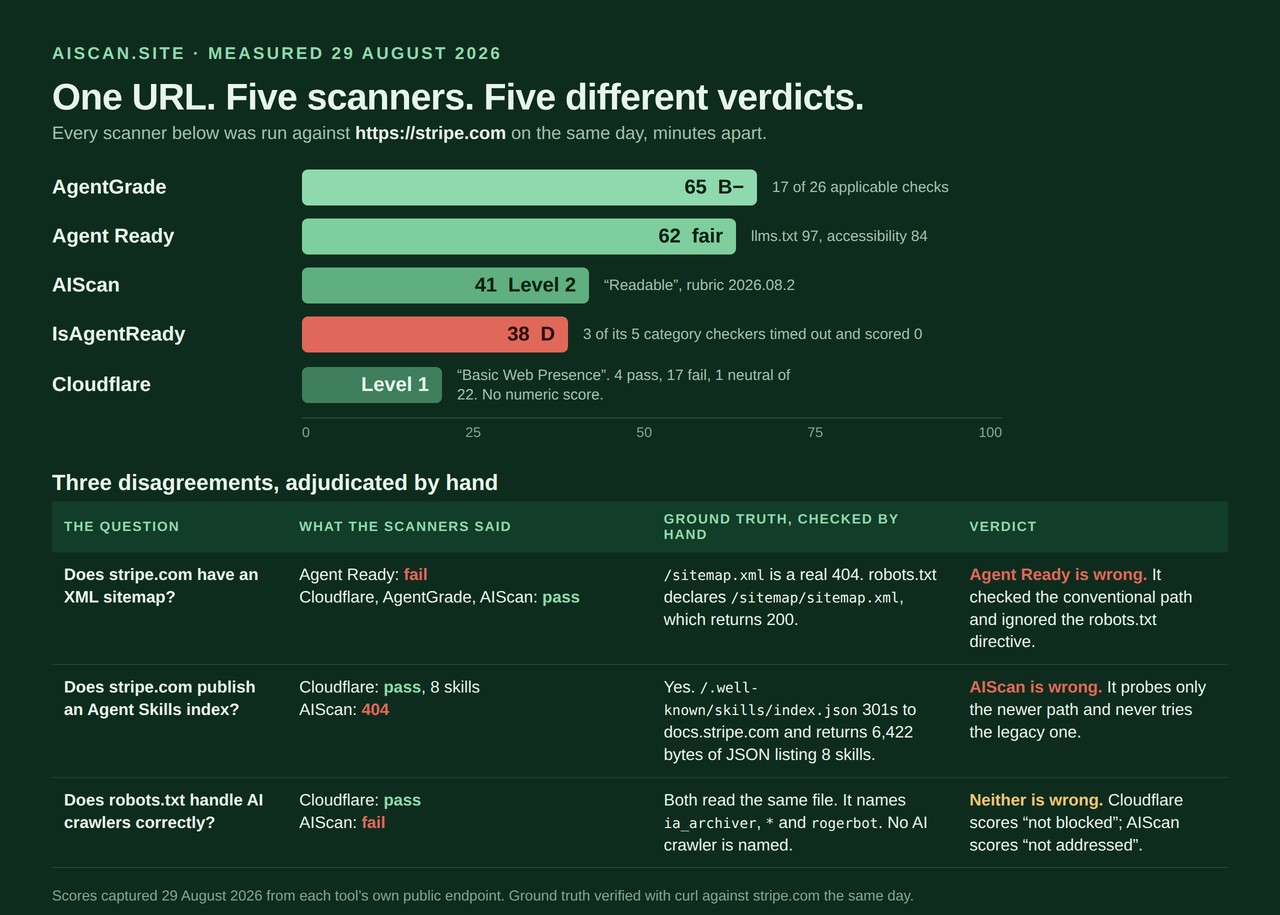
The result: five of the ten produced a score for https://stripe.com. Those scores were 65, 62, 41, 38 and "Level 1". Two of the ten returned an answer that was factually wrong about the site, and one of the two wrong answers was ours.
Quick summary: which scanner to use, and for what
| If you want to… | Use | Why | Cost |
|---|---|---|---|
| See the raw evidence behind every verdict | Cloudflare's isitagentready.com | Returns the full fetch chain, including the paths it tried and abandoned | Free, no account |
| Run a check on every pull request | AgentGrade | GitHub Action plus an open GET endpoint | Free, no pricing page exists |
| Get the most checks against a single page | Agent Ready | 73 individual results returned on our scan | Free tier, Pro $19/mo |
| Get fixes written for your actual CMS | AIScan | Platform-aware remediation, versioned public rubric | Free scan, no account |
| Publish weights before you trust the score | IsAgentReady | Category weights printed on its own about page | Free |
Start with the free scan, then read your robots.txt yourself. No scanner in this group agreed with any other on all three of the disagreements we found. The score is a starting point for a conversation with your own site, not a verdict on it.
The single most useful finding: a scanner that reports a missing file has usually checked one path. Stripe publishes an Agent Skills index. Two scanners found it, two reported a 404, and the file is real.
How we tested
The criteria came first, before any tool was run, and they were chosen so that a tool could win on them without us winning:
- Can it be run without an account? A scanner behind an email form is a lead magnet with a scanner attached.
- Does it show its evidence? A number with no fetch log cannot be checked or argued with.
- Does it publish its rubric or weights? A hidden rubric is an opinion presented as a measurement.
- Does it tell you how to fix what it found? Detection without remediation moves the work, it does not do it.
- Was it right? Where two tools disagreed, we fetched the underlying artifact by hand and settled it.
The test subject was https://stripe.com, picked because it is large, well-engineered, publicly examined, and belongs to nobody in this comparison. Every tool was pointed at that one URL between 14:00 and 14:20 UTC on 29 August 2026. Where a tool exposed a public endpoint, we called it directly and recorded the raw JSON. Where it did not, we recorded why, and we did not estimate a score in place of one we could not obtain.
We did not create an account, submit an email address, or pay for anything. That biases the results toward tools that let you in without a transaction, which is deliberate: it is the same bias a reader has at the moment they are looking for a scanner.
The ten scanners side by side
| Tool | Ran it? | Result for stripe.com | Checks | Evidence shown | Fixes | Free tier |
|---|---|---|---|---|---|---|
| AgentGrade | Yes, open GET | 65, grade B− (17 of 26) | 70+ claimed | Partial | No | Free, unlimited |
| Agent Ready | Yes, POST | 62, "fair" | 71 claimed, 73 returned | Yes | Yes | 10 scans/30 days |
| AIScan | Yes, open GET | 41, Level 2 "Readable" | 21 scored | Yes | Yes, platform-aware | Free, no account |
| IsAgentReady | Yes, open GET | 38, grade D (degraded) | Not published | Partial | Partial | Free |
| Cloudflare | Yes, POST | Level 1, "Basic Web Presence" | 22 | Yes, full fetch chain | Next-level prompts | Free, no account |
| Search Engine Land / Semrush | No, browser only | Not obtained | Not published | No | Yes | Free |
| WordLift AI Audit | No, HTTP 403 | Not obtained | Not published | No | Yes | Free |
| SiteSpeakAI | No, CSRF 419 | Not obtained | Not published | No | Yes | Free |
| aireadinesschecker.com | No, email required | Not obtained | Not published | No | Yes | Free with email |
| Apify actor | No, account required | Not obtained | Not published | Unknown | Unknown | Pay per usage |
The five that produced a score
1. Cloudflare's Agent Readiness check: best for evidence you can audit
The tool at isitagentready.com shipped alongside Cloudflare's Agent Readiness announcement on 17 April 2026. It refuses to give a number. Instead it returns a level, and stripe.com came back at Level 1, "Basic Web Presence", with 4 checks passing, 17 failing and 1 neutral out of 22.
What separates it from everything else in this list is the evidence array. For every check it returns the requests it made, in order, with status codes and response headers, and a one-line finding for each. That is how we learned it tries two different Agent Skills paths, and it is why this tool caught something four others missed.
| Pros | Cons |
|---|---|
| ✅ Full fetch chain returned for every check | ❌ No numeric score, so no trend line over time |
| ✅ Free, no account, open POST endpoint | ❌ Heavily weighted toward emerging protocols most sites do not implement |
| ✅ Names the next level and what it requires | ❌ Says nothing about how to fix anything on your CMS |
Best for: an engineer who wants to see what was actually requested before believing a verdict.
2. AgentGrade: best for continuous integration
AgentGrade scored stripe.com at 65%, grade B−, from 17 of 26 applicable checks across 7 of 12 applicable groups. Its catalog is larger than that; groups it judged irrelevant to the site, including Machine Payments and MCP endpoint discovery, were skipped rather than counted as failures. That is the most defensible scoring decision any tool in this group makes, and it is a large part of why its number is the highest.
It publishes a GitHub Action, a CLI and an MCP server, so a readiness check can gate a pull request. There is no pricing page. /pricing and /docs both return 404, and no paid-tier language appears anywhere on the site, so the tool appears to be free.
| Pros | Cons |
|---|---|
| ✅ Skips inapplicable groups instead of failing them | ❌ No pricing page at all, which makes its future uncertain |
| ✅ GitHub Action for pull-request checks | ❌ Its published benchmark stat is dated May 2026 and appears static |
| ✅ Open GET endpoint, no key needed | ❌ Evidence is thinner than Cloudflare's |
Best for: a team that wants readiness to fail a build rather than appear in a monthly report.
3. Agent Ready: best for depth on one page
Agent Ready returned 62, labelled "fair", alongside three sub-scores: llms.txt 97, accessibility 84, and a percentile of 65 against a corpus of 1,410 sites. That corpus figure is the only comparative baseline any of these tools volunteered, and it is worth more than the headline number.
Our scan returned 73 individual check results, 54 passing and 17 failing. The free tier allows 25 pages per scan and 10 scans per 30 days once signed in, with keyless CLI and MCP scans at a per-IP rate. Pro is $19/month for 250 pages per scan, 50 scans a month, 90-day history, weekly monitoring and REST API access (pricing page, fetched 29 August 2026). It also accepts x402 machine payments at $0.02 per 25-page scan.
| Pros | Cons |
|---|---|
| ✅ Most individual results of any tool tested | ❌ Produced one of the two wrong answers we found |
| ✅ Publishes a percentile against a real corpus | ❌ Free tier requires a sign-in for the full allowance |
| ✅ Cheapest paid tier in the category | ❌ Checks conventional paths without following declarations |
Best for: auditing one important page in depth rather than a whole site cheaply.
4. AIScan: best for fixes written for your CMS
Our own scanner put stripe.com at 41, Level 2 "Readable", under rubric version 2026.08.2. That is the third-lowest number in this comparison and lower than two competitors, which is the honest result and we are publishing it as it came back.
The gap is explained by weighting rather than by disagreement about facts. AIScan gives 8 points to Markdown content negotiation (C1) and 5 to explicit AI bot rules (B2), both of which stripe.com fails, while its discoverability dimension scored a full 100. It also scored two things nobody else reported: 4,782 words of server-rendered text under E3, and a correct hard 404 on a probe path under E1.
It got one thing wrong, described in full below. It also misidentified the platform, reporting stripe.com as a Lovable site at 50% confidence on the strength of a /_next/static/ asset and the string "lovable" appearing somewhere in a JavaScript bundle. That is a false positive in the platform detector and it is being fixed.
| Pros | Cons |
|---|---|
| ✅ Remediation written for the detected CMS | ❌ Missed the Agent Skills index by checking one path |
| ✅ Public versioned rubric, 2026.08.2 | ❌ Platform detector produced a false positive on this site |
| ✅ Free scan, no account, CLI and MCP | ❌ Scores stricter than most, which reads harsh on good sites |
Best for: someone who has a score and now needs the exact change to make in WordPress, Shopify or Next.js.
5. IsAgentReady: best for published weights, when it completes
IsAgentReady returned 38, grade D. That number should not be trusted, and the tool is transparent enough to show you why: three of its five category checkers reported "Checker error" after timing out at 15,000ms, and each was scored as zero. AI Search Signals, Agent Protocols and Security & Trust all failed to run. The two categories that did complete scored 69% and 87%.
Its weights are printed on its own about page: AI Content Discovery 30%, AI Search Signals 20%, Content & Semantics 20%, Agent Protocols 15%, Security & Trust 15% (fetched 29 August 2026). Publishing weights is rare and good. It does not publish a check count.
| Pros | Cons |
|---|---|
| ✅ Weights published openly, per category | ❌ Three of five checkers timed out on our test |
✅ Free, open /api/v1/scan/{domain} endpoint | ❌ Timeouts score as zero rather than as "unknown" |
| ✅ Publishes an OpenAPI document | ❌ No published check count |
Best for: understanding how a weighted readiness rubric is put together, once you have re-run a failed scan.
The five we could not run, and why that is the finding
Half of this category cannot be used by an agent, which is a strange property for a tool that grades whether your site can be used by an agent.
- Search Engine Land / Semrush's checker is free and carries the most authority of anything here. Fetched without a browser it returns a loading shell listing its own steps, including that it tests 15 ChatGPT citation prompts. The score arrives only after client-side JavaScript runs.
- WordLift's AI Audit returns HTTP 403 with the body
{"error":"Access denied. Please use the web application."}. It does publish a WebMCP tool manifest describing arun-audittool, which is a browser-side interface rather than a callable endpoint. - SiteSpeakAI's scanner returns HTTP 419,
{"message":"CSRF token mismatch."}. It is a Laravel form that needs a live session. - aireadinesschecker.com requires a URL, an email address and a marketing consent checkbox before it will scan. We do not submit email addresses to run a test.
- The Apify actor needs an Apify account and bills per usage. Its own listing showed 2 total users and 1 monthly active user when we checked, so treat it as an experiment rather than a product.
None of this makes those tools bad at scanning. It does mean their results cannot be reproduced by a reader, compared against another tool, or put in a pipeline, and a category built on measurement should care about that.
Where they disagreed, and who was right
Three checks produced contradictory verdicts on the same site on the same day. We fetched each underlying artifact by hand with curl to settle them.
Disagreement 1: the sitemap. Agent Ready was wrong.
Agent Ready reported S8 sitemap.xml not found, a 404 at the literal path. Cloudflare, AgentGrade and AIScan all passed the same check.
Ground truth: https://stripe.com/sitemap.xml really is a 404. But stripe.com's robots.txt opens with Sitemap: https://stripe.com/sitemap/sitemap.xml, and that URL returns 200 with 805 bytes of valid XML. The declaration is exactly what RFC 9309 provides for. A scanner that probes the conventional path and stops has found a convention, not a fact.
Disagreement 2: the Agent Skills index. AIScan was wrong.
Cloudflare passed this check and reported 8 skills. AIScan reported HTTP 404 and marked it informational.
Ground truth: Cloudflare is right and we are not. https://stripe.com/.well-known/skills/index.json returns a 301 to https://docs.stripe.com/.well-known/skills/index.json, which returns 200, application/json, 6,422 bytes, listing 8 skills including stripe-docs, stripe-apps and connect-recommend. Cloudflare's evidence log shows exactly how it got there: it requested the newer /.well-known/agent-skills/index.json path first, received a 404, logged "v0.2.0 path returned 404 — trying legacy path", and fell back.
AIScan probes only the newer path. Its own remediation text names /.well-known/agent-skills/index.json and nothing else. A real, published, spec-valid skills index was reported as absent, and it took a competitor's scanner to show us. The P3 check is being changed to try both paths and follow redirects.
Disagreement 3: robots.txt and AI crawlers. Neither was wrong.
Cloudflare passed robotsTxtAiRules with the message "No AI-specific bot rules; wildcard rules apply to all crawlers including AI bots." AIScan failed B2 with the evidence "0 known AI agent(s) addressed in robots.txt."
Both read the same file and described it accurately. stripe.com's robots.txt names three user agents: ia_archiver, * and rogerbot. Not one AI crawler appears. Cloudflare scores that as a pass because nothing is blocked. AIScan scores it as a failure because nothing is declared, which matters given how many AI crawler user agents now exist and that Google's robots.txt specification applies only the single most specific matching group, so a bot with its own group never reads your wildcard rules.
This one is not a bug in either tool. It is two different opinions about what "ready" means, expressed as a number.
Why the scores diverge
Once you have adjudicated the disagreements, the 24-point gap between the highest and lowest clean score stops looking like error and starts looking like disclosure.
| Cause | Effect on the score | Seen in |
|---|---|---|
| Emerging protocols weighted heavily | Sites without MCP, x402 or A2A score low regardless of content quality | Cloudflare, AgentGrade |
| Inapplicable groups skipped, not failed | Raises the score for sites the group does not apply to | AgentGrade |
| Inapplicable groups counted as failures | Depresses scores on non-commerce sites | Cloudflare |
| A timeout scored as zero rather than unknown | Understates the score, silently | IsAgentReady |
| Conventional paths probed without following declarations | Produces false negatives on correctly configured sites | Agent Ready, AIScan |
| Content and rendering weighted over protocols | Rewards server-rendered prose, punishes missing negotiation | AIScan |
The practical consequence: a readiness score is not portable between tools, and comparing your score to a competitor's on a different scanner is meaningless. Pick one, record the rubric version, and track the trend.
A dated timeline of this category
| Date | What happened | Why it matters |
|---|---|---|
| 3 Sep 2024 | llms.txt proposed by Jeremy Howard | Gave every later scanner its first check |
| 17 Apr 2026 | Cloudflare ships Agent Readiness and isitagentready.com | A CDN with real traffic data defines a level scale |
| ~15 Jun 2026 | Google states it ignores llms.txt for Search rankings | Splits "readable by agents" from "ranks on Google" |
| 10 Aug 2026 | llms.txt v2 adds rel="describedby" link relations | Most validators still check v1 only |
| 29 Aug 2026 | This test | Ten tools exist; five will give an agent a score |
Which scanner to run, based on what you already know
The reader who arrives here has usually already run one scan. Branch on what it said.
- You got a score you think is too low. Re-run on a second tool before changing anything. Two of the five wrong-looking results here were the scanner's fault, not the site's. Check whether a failed item is a file the scanner looked for at one path.
- Two tools disagree on a specific file. Fetch it yourself:
curl -sIL https://yoursite.com/<path>. Follow redirects with-L. A 301 to a docs subdomain is what defeated our own check. - Every tool agrees you fail Markdown negotiation (C1) and llms.txt (C2). Those are the two most commonly failed checks in this whole category and the two most easily fixed. Start there.
- Your score is fine but your content is not appearing in AI answers. Readiness is not visibility. Check first whether your pages are server-rendered at all, because a site can rank on Google and be invisible to ChatGPT.
- A scanner reports a file missing that you know you published. Ask it which path it requested. If it will not say, that is your answer about the scanner.
What to do after a bad score
A low score is a work queue, not a diagnosis. In order, cheapest first:
- Run the free scan and read the check IDs, not the number.
npx aiscan-cli yoursite.com, or paste the URL at aiscan.site. It names the specific checks: C1 Markdown content negotiation, C2 llms.txt, C3 and E3 server-rendered HTML, B2 explicit AI bot rules, D2 XML sitemap, P3 Agent Skills index. If you would rather check by hand,curl -sI -H 'Accept: text/markdown' https://yoursite.com/answers C1 in one line, andcurl -s https://yoursite.com/robots.txtanswers B2. - Fix llms.txt and robots.txt first. They are files, not architecture, and they move three checks between them. The llms.txt generator will build a valid one from your sitemap.
- On WordPress, use one plugin rather than three. ThinkRank handles robots.txt, robots meta, schema, sitemaps and llms.txt from a single place, which is the answer to the usual problem of three SEO plugins each rewriting the same robots.txt. It migrates settings from Rank Math, Yoast, All in One SEO and SEOPress, so switching costs nothing in re-entered configuration. Rank Math and Yoast both remain stronger on classic on-page SEO workflows and editorial scoring, and if that is the bulk of your work they are reasonable choices; neither generates llms.txt.
- On Shopify, StoreSEO is the shortest path to llms.txt, agents.md and product schema generated from your real catalog rather than hand-maintained. It is rated 5.0 from 685 reviews on the Shopify App Store as of 27 August 2026. Yoast SEO for Shopify is the main alternative and is stronger on editorial metadata; it does not generate llms.txt.
- Re-scan and record the rubric version. A score without a rubric version cannot be compared to itself next month.
Nobody in this category publishes a recovery timeline, ourselves included, because no crawler operator publishes re-crawl intervals. What is documented is propagation after a robots.txt change: OpenAI roughly 24 hours, Perplexity up to 24 hours, Amazon roughly 24 hours with robots.txt cached up to 30 days, DuckDuckGo 72 hours.
Where AIScan fits, and where it doesn't
| Question | Best answered by |
|---|---|
| What exactly did the scanner request? | Cloudflare's tool. Its evidence array is the best in the category. |
| Should this fail my build? | AgentGrade's GitHub Action. |
| How deep can I audit one page? | Agent Ready, 73 results on our scan. |
| What do I change, in my CMS, right now? | AIScan. Nothing else here writes platform-specific fixes. |
| How is a weighted rubric constructed? | IsAgentReady's published weights. |
| Am I being cited by ChatGPT today? | None of them. That is visibility monitoring, a different product category. |
What AIScan cannot see. It cannot tell you whether an AI assistant actually cites you, because that requires prompt sampling rather than crawling. It cannot tell you whether a crawler executed your JavaScript, because no operator documents rendering behaviour. It cannot see anything behind a login. And, as this test established, it cannot currently see an Agent Skills index published at the legacy path. If you are choosing on evidence quality alone, Cloudflare's tool is better than ours; if you are choosing on CI integration, AgentGrade is. Our older roundup of free AI readiness checkers covers the wider set of free tools, including visibility monitors this test excluded.
Your 10-minute checklist
- Run one free scan, no account:
npx aiscan-cli yoursite.com - Run a second scanner on the same URL and compare check by check, not score to score
- For any file reported missing,
curl -sILthe path yourself and follow redirects - Read your robots.txt and count how many AI crawlers it names
- Test
curl -sI -H 'Accept: text/markdown' https://yoursite.com/for C1 - Confirm your sitemap is declared in robots.txt, not just present at the conventional path
- Record today's date and the rubric version alongside the score
Run the same test on your own site
Run the scan on your own site and read the check IDs rather than the number: npx aiscan-cli yoursite.com, or paste the URL at aiscan.site, free and without an account. The checks this article turned on are C1 and C2 under content, B2 under bot access, P3 under capabilities, and D2 and E1 under discoverability. Then run a second scanner and see whether it agrees. Where it does not, the disagreement is usually more informative than either score.
Every check in the rubric is documented at aiscan.site/guides, and if llms.txt is one of your failures, the llms.txt generator will build a valid file from your sitemap in about a minute. The evidence on whether that file is read by anyone is in our llms.txt review.
Testing and analysis by M Asif Rahman. All scans run 29 August 2026 against the tools' own public endpoints; raw results available on request.
Frequently asked questions
My scanner says my llms.txt is missing, but I can open it in a browser. What is wrong?
The scanner almost certainly requested a different path, or did not follow a redirect. Ask the tool which URL it fetched. In this test, Stripe's Agent Skills index was reported as a 404 by two scanners because it lives at /.well-known/skills/index.json and 301s to a docs subdomain, while those scanners only probed the newer /.well-known/agent-skills/index.json path. Verify it yourself with curl -sIL https://yoursite.com/<path> and read the redirect chain before changing anything on the site.
Why did two AI readiness scanners give my site completely different scores?
Because they weight different things and do not share a rubric. On 29 August 2026 the same URL scored 65 on AgentGrade, 62 on Agent Ready, 41 on AIScan and 38 on IsAgentReady, and Cloudflare's tool returned no number at all. AgentGrade skips check groups it judges inapplicable, Cloudflare weights emerging protocols heavily, and AIScan weights Markdown content negotiation and explicit AI bot rules. Compare a score only against itself over time, and record the rubric version.
A whole category in my scan came back as 0. Is my site really that bad?
Check whether the category actually ran. IsAgentReady returned 38 out of 100 for stripe.com, but three of its five category checkers reported a checker error after timing out at 15,000ms and each was recorded as zero rather than as unknown. Re-run the scan before you believe a category that scores exactly zero, especially if the two categories that did complete scored well.
Which AI agent readiness scanner is the most accurate?
None of them was right about everything. Agent Ready reported a missing sitemap that is declared in robots.txt and returns 200, and AIScan missed a published Agent Skills index. Cloudflare's isitagentready.com was the only tool that returned the full fetch chain for every check, which is what let us settle the disagreements. Accuracy here is best judged by whether a tool shows its evidence, not by which number it produces.
Are any of these AI readiness scanners free?
Most are. AgentGrade, IsAgentReady, Cloudflare's isitagentready.com and AIScan all ran without an account on 29 August 2026. Agent Ready has a free tier of 10 scans per 30 days and a Pro plan at $19 per month. Search Engine Land's Semrush-powered checker, WordLift's AI Audit and SiteSpeakAI's scanner are free but browser-only. aireadinesschecker.com requires an email address, and the Apify actor requires an Apify account and bills per usage.
Can I run an AI agent readiness check in continuous integration?
Yes. AgentGrade publishes a GitHub Action so a readiness check can gate a pull request, and it also exposes an open GET endpoint that needs no key. Agent Ready and AIScan both ship a CLI and an MCP server, so npx aiscan-cli yoursite.com can run in a pipeline step. Cloudflare's tool has a public POST endpoint but no packaged CI integration.
Does a high agent readiness score mean ChatGPT will cite my site?
No. Readiness and visibility are different measurements. A readiness scanner checks whether your content can be fetched, parsed and used by an agent. Whether an assistant actually cites you depends on prompt sampling and on the assistant's own index, which no crawler-based scanner can see. Treat readiness as a precondition rather than as a prediction.
How often should I re-scan, and what should I record?
Re-scan after any change to robots.txt, your sitemap, your rendering strategy or your CMS, and otherwise monthly. Record the date, the tool, the rubric version and the individual check IDs rather than the headline score. AIScan's rubric was version 2026.08.2 for the scans in this article; a score without a rubric version cannot be compared against itself later.

About the author
M Asif Rahman
Entrepreneur, curious about AI
I have been building companies for a long time, and lately most of my curiosity goes to AI. AIScan is a small personal project I built on a flight from Dubai to Narita. I use it to understand how ready the web is for AI agents, and I share what the scans teach me.
Related guides
AI readiness setup guide by platform (2026)
Verified 17 and 18 October 2026. Updated on 18 October 2026. An AIready site needs six things: a robots.txt that names AI crawlers D1, B2, a sitemap D2, a declared feed E5, an llms.txt C2, and…
Which Agent-Readiness Checks Travel Together: 739 Sites, Three Bundles
Fix one agentreadiness check and a second one often moves with it. Fix another and nothing else changes. A scan report lists every check as its own line, so the reader cannot see which lines are…
The complete AI readiness setup for Wix in 2026
Every other platform in this series asks you to create something. Wix has already created it. Before you open a single panel, a Wix site is serving a robots.txt, a sitemap index, serverrendered HTML…